Markov 1913 and the Missing Piece
When Russian mathematician Pavel Nekrasov looked at "moral statistics," with its yearly rates of crimes, suicides, and marriages, he noticed something unsettling: the data was flat.

The number of murders or marriages in a country barely moved from year to year, almost as if something was holding it steady. The data represented aggregates of countless individual human choices, and yet the totals behaved like clockwork.
He drew the conclusion that these rates followed the law of large numbers, that they had converged and reached their expected average. But he also added a fatal premise: that the law of large numbers ONLY holds for independent events like coin-tossing.
Therefore, he argued, the underlying choices by the individuals behind these rates acted independently; each person was acting out of free will. Which is a bold assumption, to say the least.
Markov: Hold my Beer
In 1906, the paper caught the eye of the young Andrey Markov, nicknamed "Andrei the Furious," especially the claim that the law of large numbers only held for independent events.
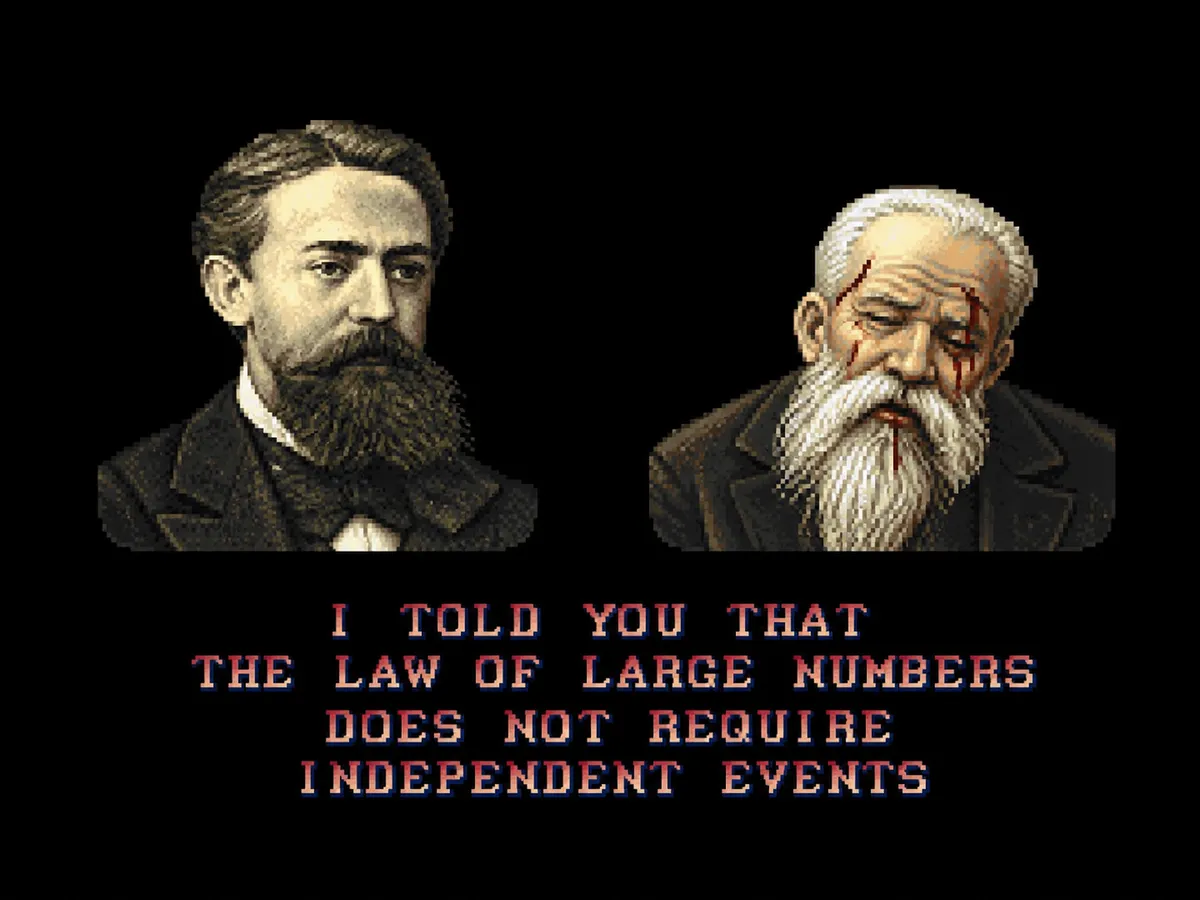
To prove Nekrasov wrong, Markov constructed a system where each state leans on the previous one, known as the Markov chain. He then proved that a Markov chain will still, if run long enough, settle on the expected averages, as long as such a chain keeps moving freely between all states.
1913 Experiment
But the system was merely an abstract concept, and Markov needed to prove that the chains actually existed in real life.
So, 7 years after he had constructed the Markov chain, he sallied out to find a sequence that behaved like a chain, and he found it in the poem Eugene Onegin by Alexander Pushkin.
He figured that the letters making up words are dependent on each other and able to flow freely between vowels and consonants.
He validated this by first establishing that the 20,000-letter poem included 43% vowels and 57% consonants. He then did something very clever. He broke the text into consecutive letter-pairs and counted how often a vowel was followed by another vowel. If letters were independent, it should have matched the base rate of 43%. Instead, it was only 13%, clear evidence that the previous letter shaped the next. Therefore, the sequence of vowels and consonants behaved as a dependent chain, exactly the kind of structure Markov's theory had described 7 years earlier.
The Missing Piece
One thing that Markov never did was to actually watch the sequence converge. The point of the experiment was only to show that this type of sequence existed in the real world. And it's not hard to understand why: it was tedious enough just to manually transcribe and classify a sequence of 20,000 letters by hand.
But in honor of Andrei the Furious, I created a Python script that uses the same English version of Eugene Onegin and tested whether the sequence actually stabilized.
And since we are working with the English version, we will not have the same proportion of vowels and consonants:
- Vowel-rate: 37.8%
- Consonant-rate: 62.2%
- Vowel-after-vowel-rate: 16.43%
We can already see that the vowel-after-vowel-rate does not match the baseline of 37.8%, indicating dependence between the letters in the English version as well.
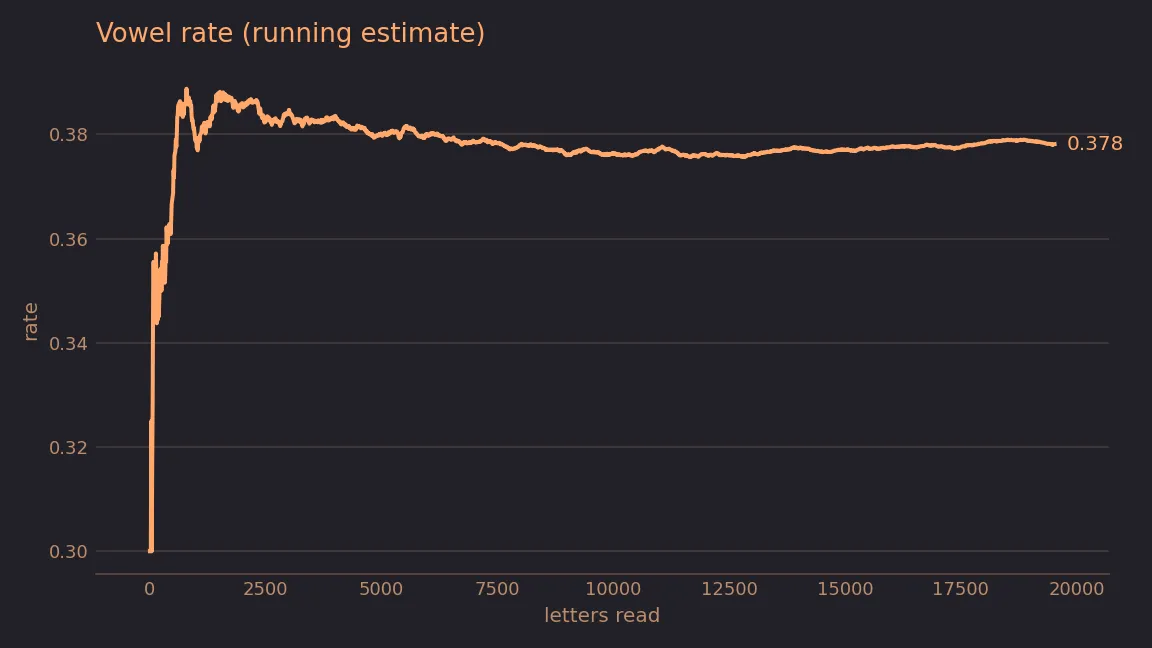
The vowel rate stabilizes at around 2,500 letters, indicating that the sequence does follow the law of large numbers.